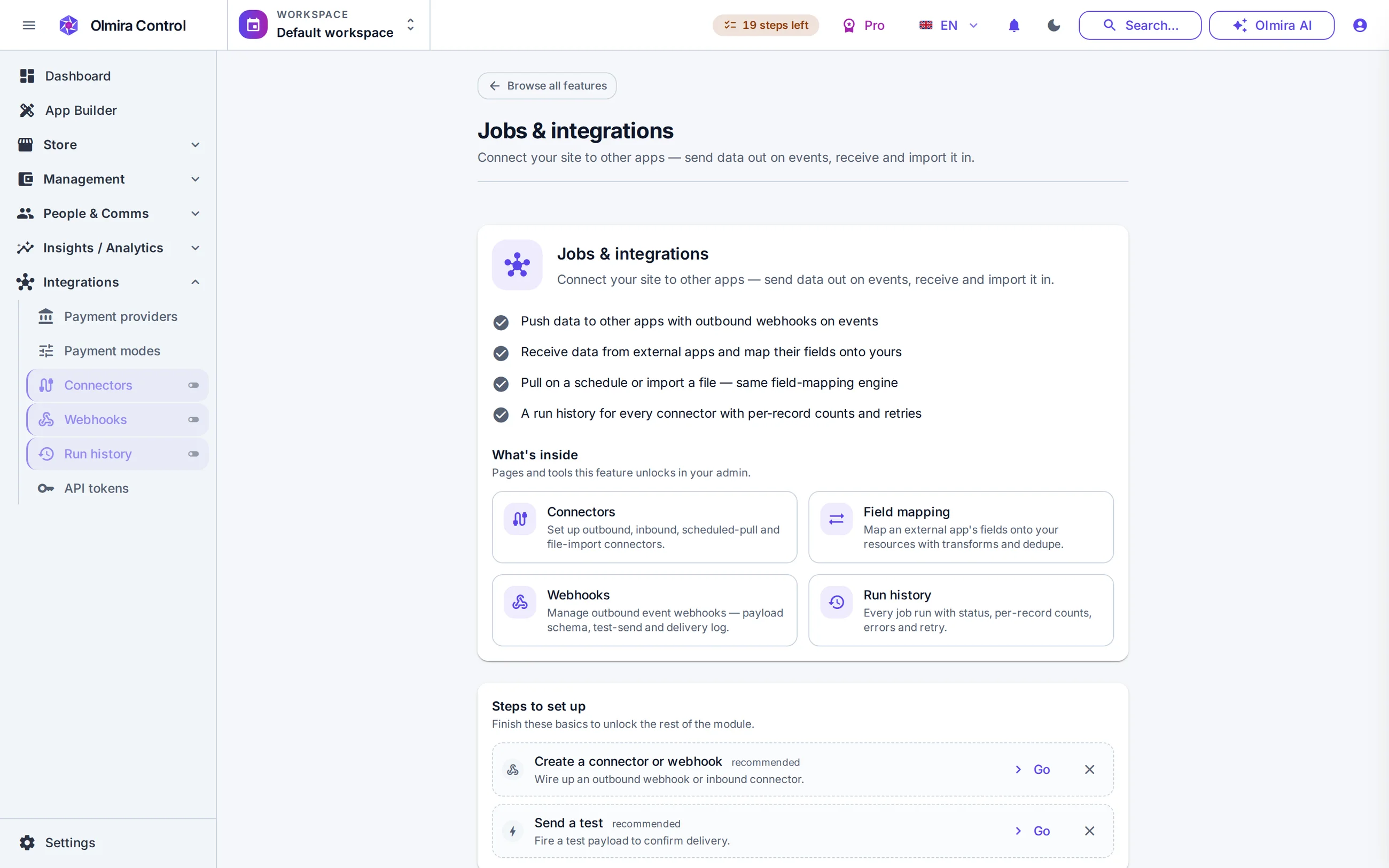
Four ways in and out of Olmira
Import a file — Upload a CSV of products, customers, orders or bookings — up to 10,000 rows per file — map the columns once, and re-run it whenever the file changes.
Pull on a schedule — Point Olmira at any HTTP endpoint and it fetches on your schedule, as often as every 5 minutes, with your API credential stored encrypted.
Receive pushes — Every connector gets its own signed endpoint. External systems POST to it; Olmira verifies the signature before touching a single record.
Send events out — 22 webhook events — orders, bookings, payments, invoices, tickets and more — delivered signed, with automatic retries when your endpoint is down.
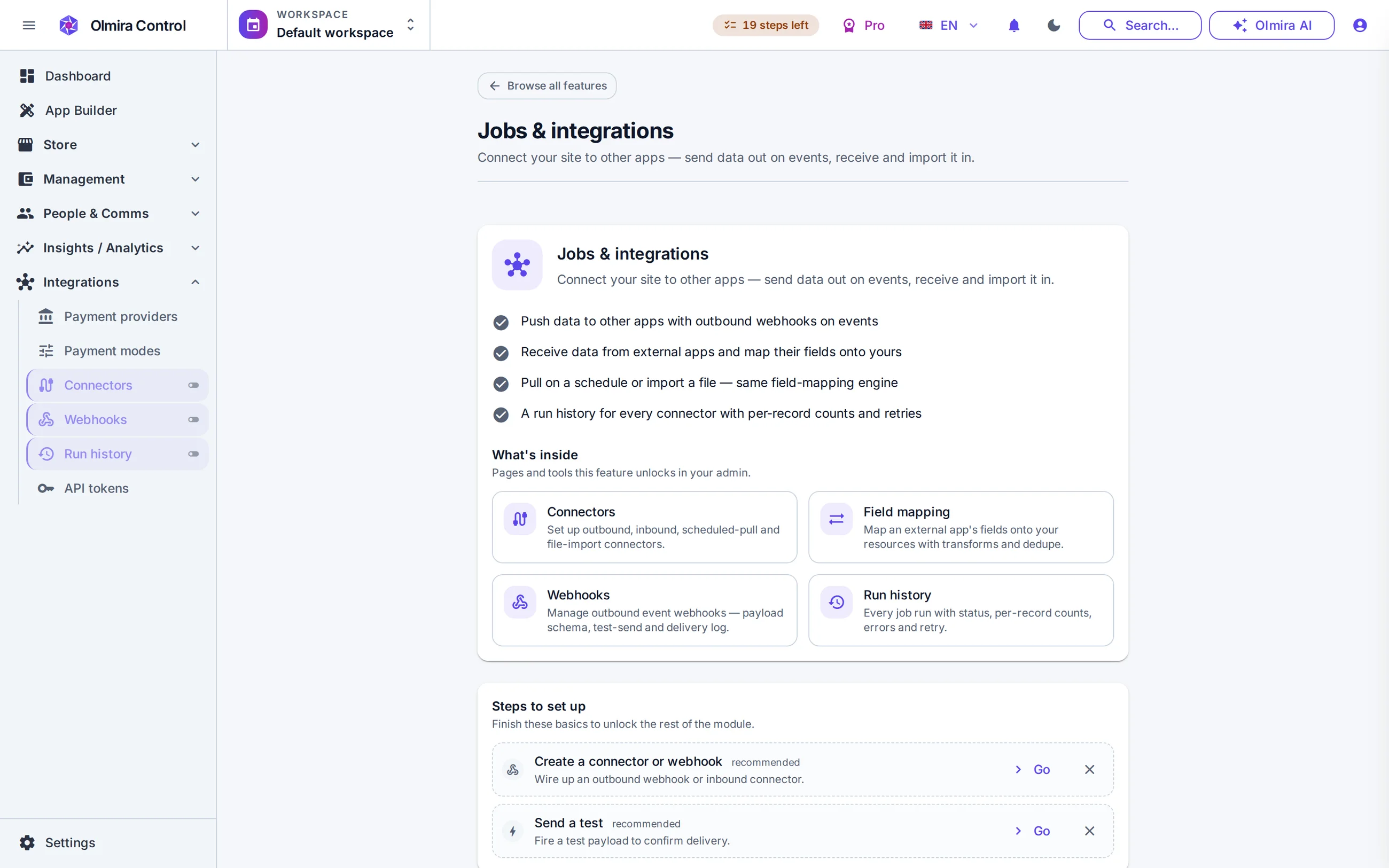
Map their fields to yours, once
Pick a source field, a target field, and optionally a transform — a default, a status remap, a date format. A dedupe key makes re-runs safe: matching records update or skip by the policy you chose, never duplicate. And the engine only writes allowlisted fields — a payload can never set an ID, an owner or a price it shouldn't. Imported products arrive as drafts; imported contacts are never marked as consented to marketing.
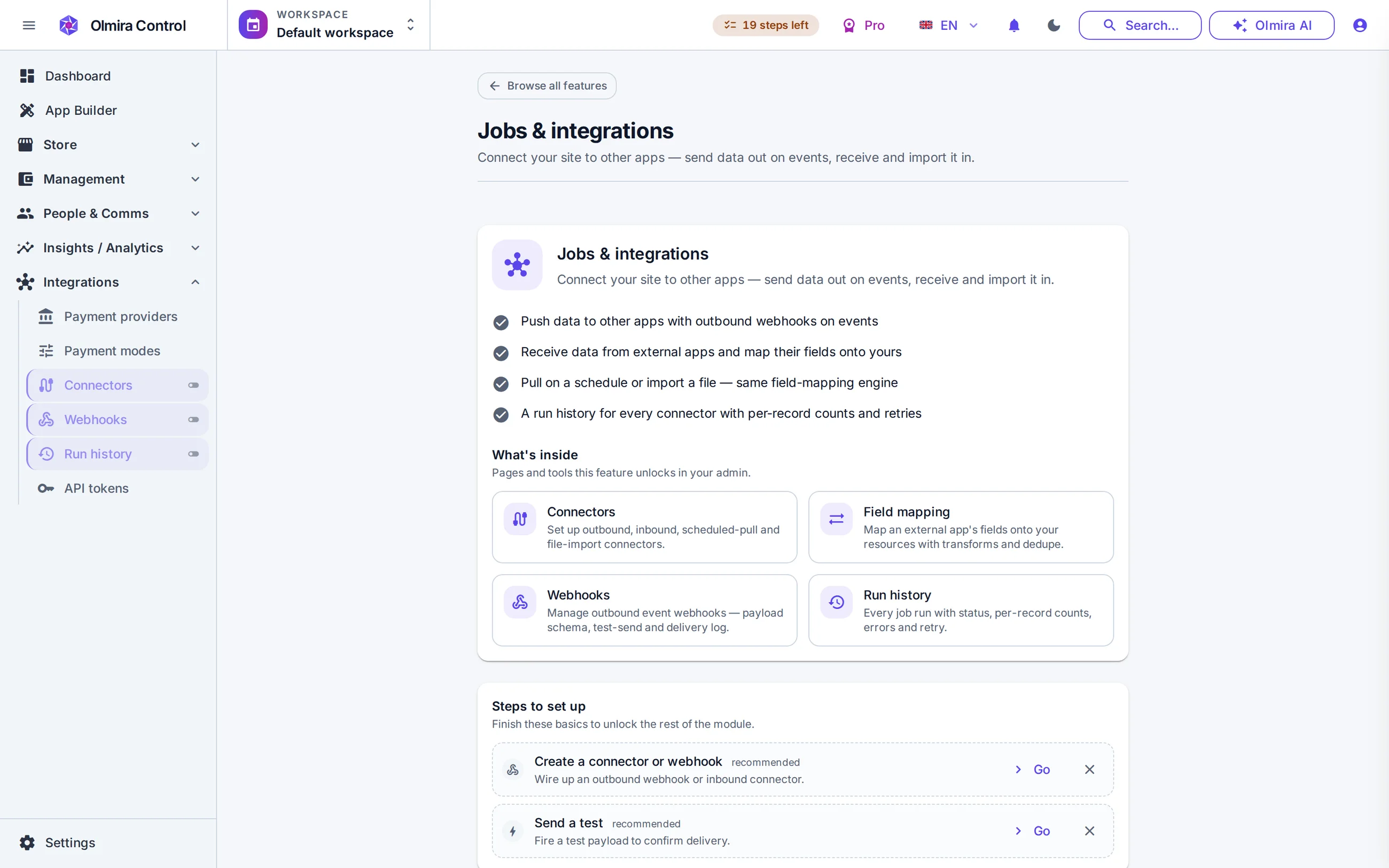
Every run leaves a record
Each import, pull and push becomes a run with a verdict: how many records were received, created, updated, skipped and failed. A single bad row fails on its own — it never aborts the batch — and failed runs retry automatically with increasing delays before landing in a dead-letter state you can inspect. When something looks off in your catalogue, the run log is where the answer is, not a support ticket.
What it costs
No. Olmira gives you generic, well-guarded pipes — file import, scheduled pull, signed push, webhooks and an API — that connect to anything speaking HTTP or CSV. If your other system has an export or an API, you can wire it.
The engine is built so it can't do so quietly. Payloads can only write explicitly mapped, allowlisted fields; imported products arrive as drafts rather than going live; a full booking slot fails that one record instead of overbooking; and every change is counted in the run log.
Each connector has its own secret, shown once at creation. Every delivery must carry a valid signature computed over the exact payload — an unsigned or tampered request is rejected before anything is read. Credentials for scheduled pulls are stored encrypted.
Delivery retries automatically, backing off from 30 seconds up to 6 hours, for up to 6 attempts per event. The endpoint's health and its delivery history are visible in Control, and you can fire a test delivery any time.